
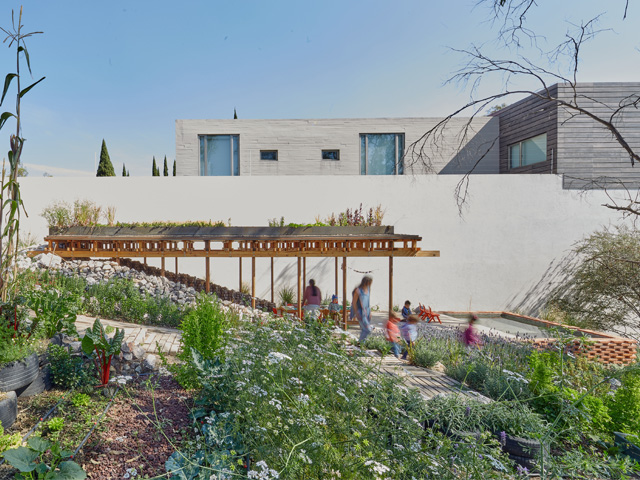
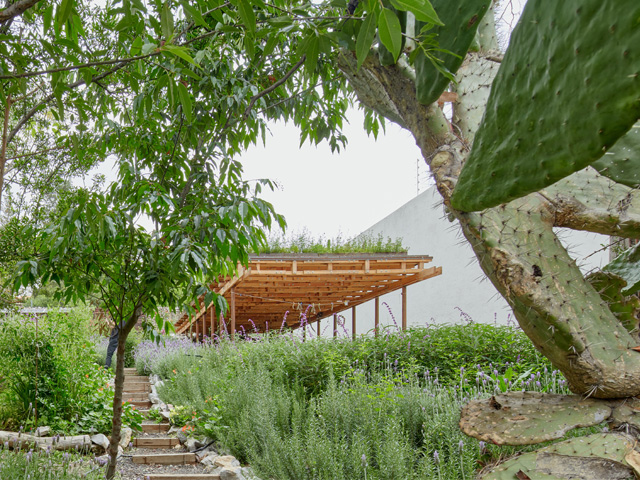
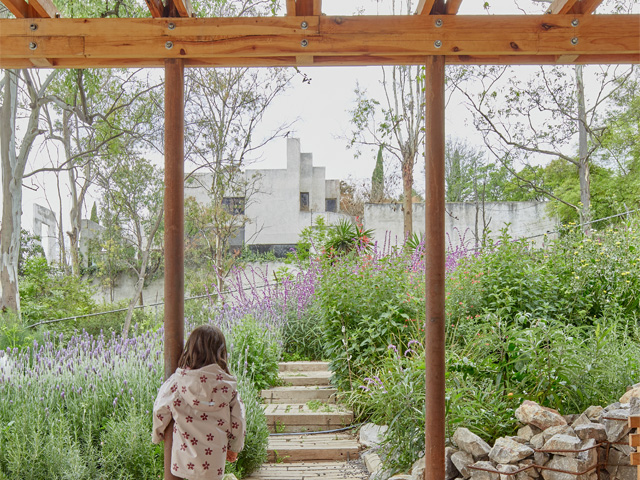
El Terreno is a community garden and educational centre project that was initiated during the Covid-19 outbreak. The project is located on a hill of rich soil, minerals and stones, providing the ingredients of an urban orchard for growing flowers, aromatic plants and vegetables.
The project was developed as a way of enabling youth in the community to remain connected to social stimulation, while simultaneously receiving an education in environmental learnings. Additionally, the project provides a closer connection to cycles of food production and sustainable living.
To be consistent with the project’s ethos, architecture and landscaping studio Vertebral constructed a unique pavilion from recycled materials garnered from previous constructions. It was important for the firm to successfully build a 100 percent recyclable building, but also a space built using materials, modules and units uniquely thought-out through new processes developed for this particular project.
In explaining El Terreno, the Mexico City-based architects said, “We focused on avoiding any user predispositions when entering this new space, designed for plurality and versatility. It is a space that can only gain significance through user engagement, and through the cultivating and sharing of new ideas directed towards a healing environment.”
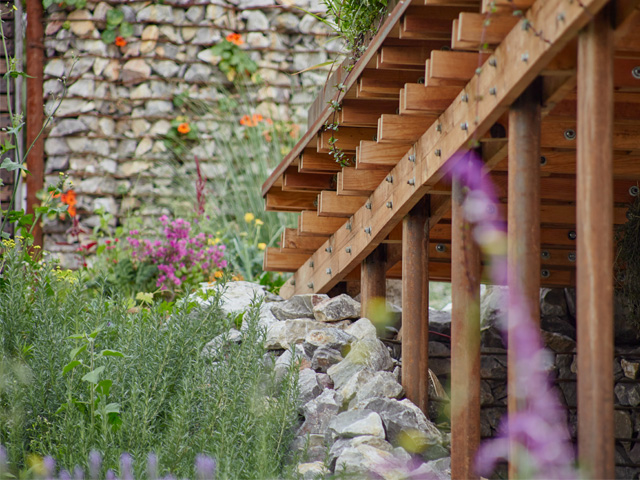
The multipurpose pavilion is built into the hillside, allowing for a gradual aperture towards the garden. Sections of iron rods were bent and welded and are contained in walls filled with stone acquired through excavation of the site. The roof is composed of wooden trusses that were once concrete formwork. Though only four different modules, all of the trusses were assembled by volunteers from the local community.
For Vertebral, it was important to create a flexible, multipurpose pavilion that reflects the firm’s vision of the future of architecture. “Strictly-defined spaces quickly become obsolete. By contrast, anonymous and ambiguous spaces are resilient and multifaceted, allowing for shifts in their significance and purpose among users.”
The founder of the project, Michelle Kalach, is deeply involved with self-sufficient communities that are off the grid. El Terreno has become a self-sustained garden through the economic stability of endemic plant and vegetable sales, cultivated through educational programs and then sold to local cafes and stores.
Rainwater is captured through a system originating on the greenroof of the pavilion, which then passes through pipes that also serve as structural columns. Finally, the rainwater descends into a cumulative body of water. From there it is pumped back into the orchard. Energy consumption is generated through solar panels, and waste from composting toilets is used as a natural fertiliser for the garden.
El Terreno is a space built as a model of how education, sustainability and design can come together to harvest a bright future that perpetually responds to immediate needs.
PROJECT PARTICULARS
Project El Terreno
Location Mexico City, Mexico
Design & Install Vertebral
Photography Ricardo de la Concha
COMPANY
Vertebral
W vertebral.mx