
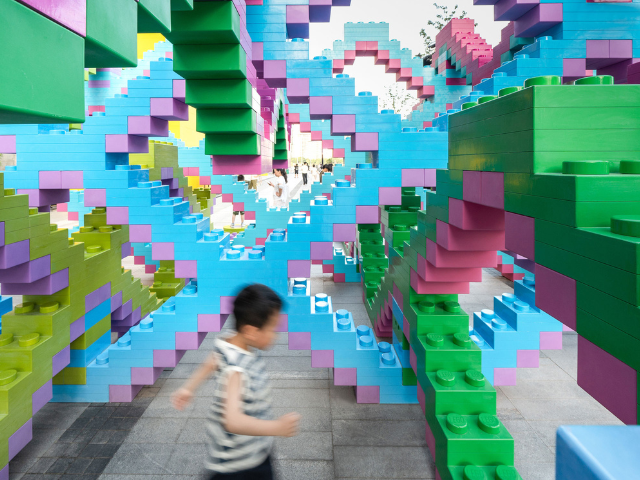
Text description provided. On June 11, 2025, the LEGO® World Play Day launched officially at Gate M, West Bund Dream Center, while putting four global cities in play mode simultaneously. Installation artist and founder of Daxing Jizi Design, Xie Qiongzhi, has been on board as one of the Playmakers of the LEGO Group. Inspired by how children see the world from an imaginative angle, she used LEGO bricks as the foundation to design and create the "The Lightweaving Playground" public art installation, thus exploring how "play" can be organically integrated into urban spaces.
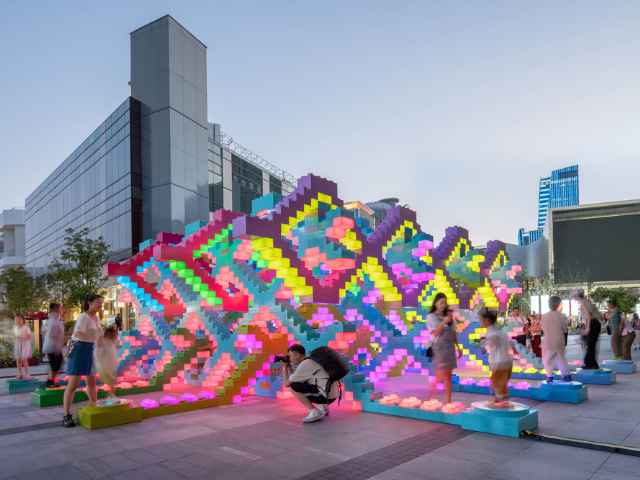
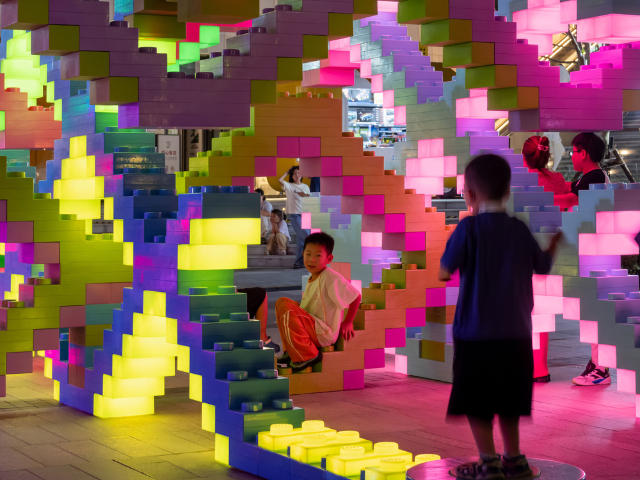
The installation is structured with a three-dimensional woven network, featuring bright colors and rich layers. Audiences can freely walk through it and activate the sound and light responses by jumping and triggering "buttons"; in this way, they can experience an imaginative "play city" in an immersive setting.
RETURNING TO INNOCENCE, ACTIVATING THE SPIRIT OF PLAY
In 1959, in an article titled "The Great Game to Come," the Dutch visual artist Constant Nieuwenhuis illustrated his vision for cities in the future. In his utopian society called "New Babylon", he envisaged a city that abandons functional utilitarianism and strives for ultimate changes and play: in this utopia, there would be vast structures combining stations, functionally interconnected spaces that stimulate the body and release the closed senses.
Today’s entertainment options have become various, but have "play" spaces in the city eventually become as imaginative as Nieuwenhuis envisioned? How should the human spirit of play return to the act of creation? In Daxing Jizi's past design practices, the city has always been a core topic of their everlasting exploration. "The Lightweaving Playground" aims to create a flexible structure in the city, a stage where people can greet, collaborate, and create sparkles together.
Unbounded by age limitations and other barriers, one can directly feel the charm of "play" as soon as one approaches the installation. "Whether being adults or children, we hope they can freely enter this space and thus be inspired by these new ideas and creativity." According to the designers, there has always been a general lack of spaces truly dedicated to "play" in today's urban public spaces. Too many spaces are filled with rational order and functional rules, gradually erasing people's most valuable spirit of "playfulness" and imagination.
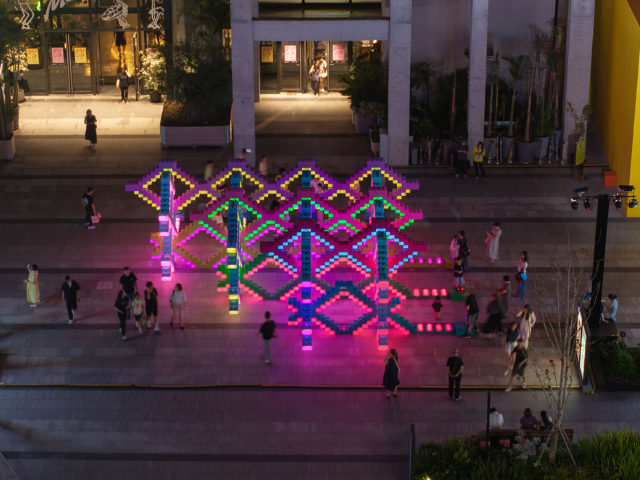
The design of "The Lightweaving Playground" is based on the instinct and intuition of human beings. Six sets of jumping "buttons" extend from the main body of the installation. Audiences can trigger the response mechanism of the light strips and sounds by stepping on the "buttons" and jumping. Such a triggering mechanism is not solely built for the sake of interactive effect, but for a return of deliberation: urban spaces that are rationalized and functionalized are given back to the rhythmic sense of the human body. The acoustic design adopts 8-bit electronic music fragments from pixel games, evoking shared childhood memories and playful emotions through simple melodies that transcend generations.
WEAVING THE CITY, PLAYING WITH COLOURS
"Weaving" is a form of expression that Daxing Jizi Design has been contemplating and exploring in their creations in recent years. As one of the oldest crafts, weaving is both a technique and a choreography of the fingertips—an ancient rhythm passed down through generations. Inspired by domestic handicrafts, Daxing Jizi's founder, Xie Qiongzhi, initiated the "Weaving City" series of creations over the past few years, envisioning a gentler, more feminine softness woven into the rigid, rule-bound structures of modern cities. "I think the ever-changing nature of weaving inherently contains rich artistic creativity. And when this handmade language is magnified and embedded into the scale of urban cities, the tension between tradition and modernity, softness and hardness, change and stability is also magnified, creating a strong sense of conflict and dialogue."
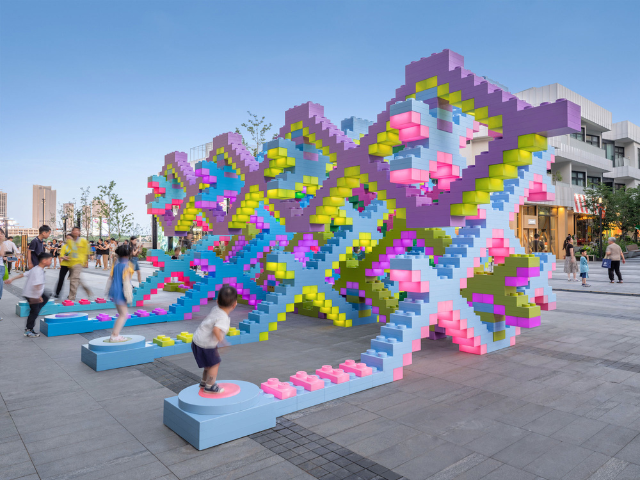
This very philosophy underpins the design of "The Lightweaving Playground", an immersive installation that reimagines woven textiles as luminous, architectural forms. Inspired by the pixelated patterns of fabric, the structure is composed of interlocking modular units—three-dimensional pixels that emulate the layered logic of weaving. Unique to this installation, however, are the intentional “breathing gaps” between components, which lend a sense of looseness and flexibility, as if the structure itself inhales and exhales with the city. The porous, lattice-like form invites movement from all directions, opening up a multitude of pathways and perspectives. It’s not just a space—it’s an invitation to explore, interact and play.
Equally essential to this woven narrative is "light". The lighting interaction system is embedded in the woven strips, and participants can trigger the flow of different light bands by activating the sensors. As dusk settles, the lit light bands weave a rhythmically distinct performance in a flowing, superimposed, and gradient manner. The designers believe that "in the concept of weaving, connection is the most important point. The interaction makes audiences feel a sense of immediate participation and collaborative weaving." Light is not only a means of illumination in the physical sense but also a medium for connecting urban memories and interpersonal emotions.
In terms of color, the installation integrates a gradient of similar colors and high-saturation contrasting colors. A base of tonal blue gradient enhances the rhythm and unity within the structure, creating an organic rhythm that flows continuously. At the same time, high-saturation contrasting colors are concentrated in the interface relationship between bricks and lights, further enhancing the sense of boundary between virtuality and reality under the nightfall light effect and transforming the installation into a vibrant spectacle from every angle.
WELCOME ON BOARD, PLAYING TOWARDS THE FUTURE
Urban planning is not only about order and function, but also carries the responsibility of bold imagination. In the concept of "The Lightweaving Playground," people are invited to participate in a "city game" with no standard answers: using body, color, and light as media to jointly weave a city that can be played in and dreamed of. Responding to Nieuwenhuis's envisioned "New Babylon," this episode presents a city designed for "people in play," a spatial proposal that seeks to break daily norms.
For Daxing Jizi Design, the work, presented as an art installation, is also a deep conversation between urban space and public art. It awakens the imagination suppressed by systems and order, introducing the possibilities of openness, participation, and fluidity into daily life.
The LEGO Group provided a creative and practical foundation for the creators. As a design language that is rich in modularity and scalability, LEGO brick system not only brings possibilities at the material level but also echoes the concept of design as an "open system."
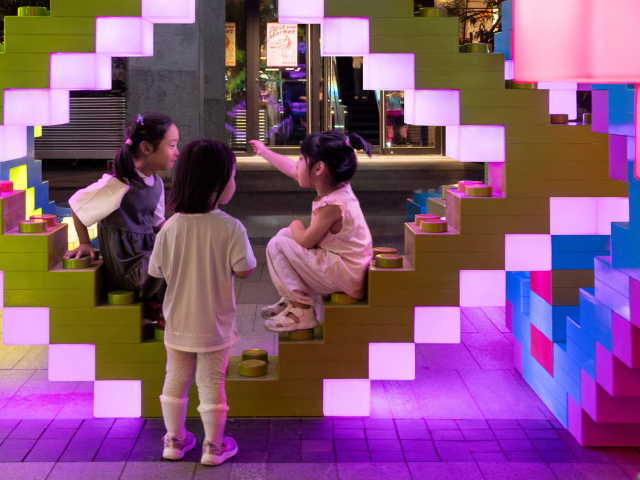
As the LEGO Group has always emphasized, "Play is not a privilege, but a right that every child should have." In terms of scale, "The Lightweaving Playground" is specially designed with a dedicated height for children, redefining urban space from their perspective. This not only reflects respect for children's physical behavior but also conveys a deeper concept: in experiencing public art, children have full and equal rights to participate. The height of the jumping buttons, the triggering mechanism, and the safety radius are all set based on children's physical abilities and behavioral rhythms, allowing them to independently complete an interactive game that lights up the city without relying on adult assistance.
After the installation was launched, the resulting playful atmosphere not only affected many surrounding viewers but also brought new inspiration to Daxing Jizi Design. Many unpredictable behaviors became the most vivid expression of the work. A viewer's comment, "Children know how to play better than adults," deeply touched the designers. Adults often unconsciously forget the powerful of play. Still, when they encounter such an art installation, their imagination and will to challenge rise. It's a vibrant urban experience to witness. Public art should not just be an object to look at but become an urban event that can be participated in and co-created: when people keenly walk into it, that is the complete appearance of the work.
LEGO® WORLD PLAY DAY: "THE LIGHTWEAVING PLAYGROUND" PUBLIC ART INSTALLATION
LOCATION Shanghai, China
ARCHITECT Daxing Jizi Design
PHOTOGRAPHY ZHANG Chao and TIAN Fangfang