
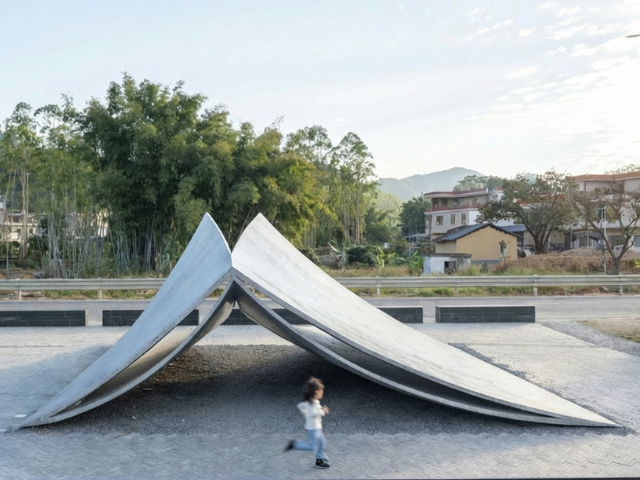
Text description provided by the architects. Located along the riverbank at the entrance to Huizhou Village of Letters, Pages Afloat marks the beginning of the visitor's journey through the site. Facing a thousand-year-old banyan tree across the water, the installation acts as a spatial threshold, introducing the literary narrative embedded within the village landscape.
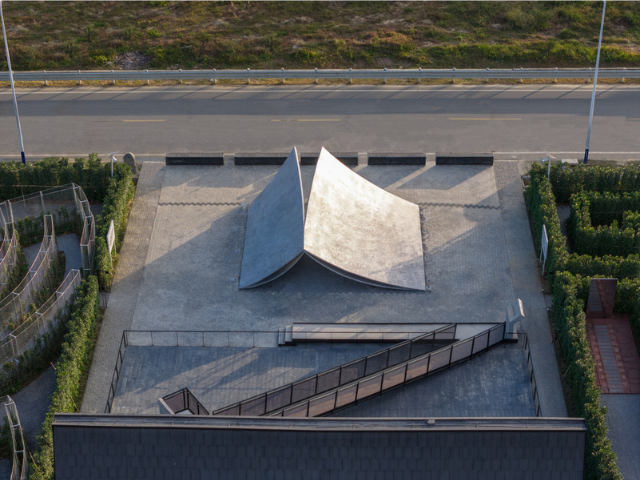
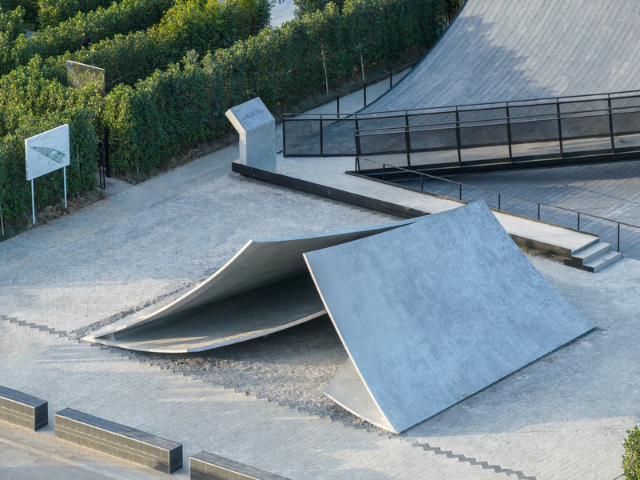
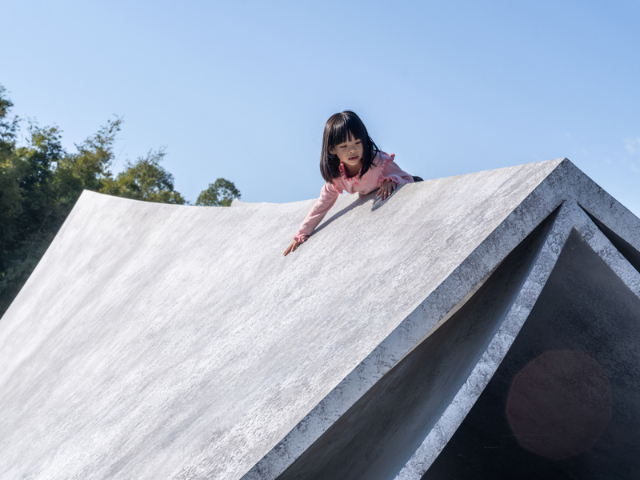
Rather than reproducing the image of a book, the design abstracts the dynamic moment of a page turning. Four curved steel surfaces emerge from the ground and rise toward a central ridge, forming a gesture of unfolding and movement. The installation is conceived not as a gate or an object, but as a spatial experience that symbolizes opening, arrival, and discovery.
The structure stands approximately 3 meters high within an 8-meter-square footprint. Four steel shells converge at a central structural core, where a stressed-skin system allows the installation to act as a unified load-bearing surface. From this point, the steel plates extend outward to create cantilevers of nearly 7 meters. The geometry gradually tapers from the center toward the edges, reducing the visual weight of the material and giving the impression of thin sheets of paper suspended in motion.
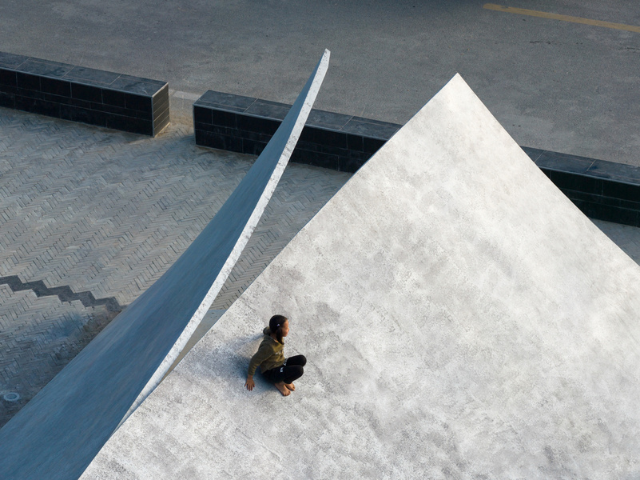
The project explores the contrast between permanence and lightness. Although constructed from stainless steel, the installation appears delicate and fluid, as if lifted by a passing breeze. The surface treatment incorporates a subtle aged texture that softens the industrial character of the metal and enhances its interaction with changing environmental conditions. Throughout the day and across the seasons, the artwork reflects shifting light, weather, and atmosphere, continuously transforming its visual presence.
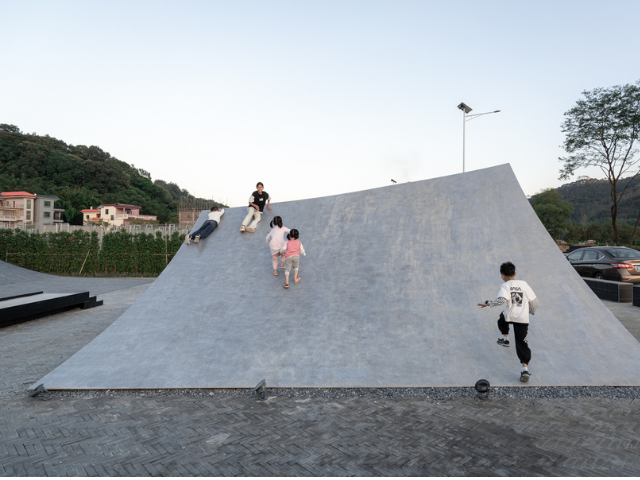
As both a public artwork and a landmark, Pages Afloat creates a moment of pause while guiding visitors deeper into the village. Passing beneath the unfolding surfaces, views are briefly framed and compressed before opening toward the wider landscape. The ancient banyan tree gradually comes into focus, establishing a visual dialogue between the site's cultural memory and its contemporary intervention.By transforming the simple act of turning a page into an inhabitable space, Pages Afloat becomes the opening chapter of Huizhou Village of Letters. It invites visitors to enter, explore, and participate in the stories that unfold beyond.
PAGES AFLOAT
LOCATION Huizhou, China
ARCHITECT f-a-n architects
PHOTOGRAPHY Fangfang Tian, Jinquan Kong