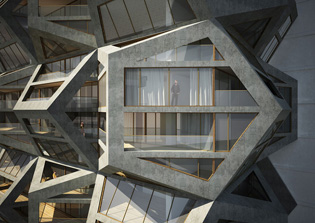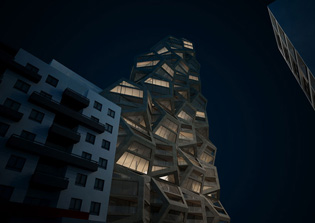

A unique housing tower based on two platonic shapes, the cube and the dodecahedron, has been proposed for Peru over a public plaza. German studio Tammo Prinz Architects developed the tessellating design as part of a competition entry for the redevelopment of a site in Lima.
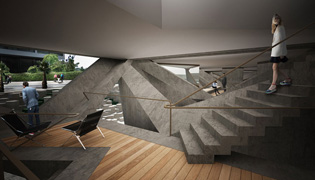
The base of the tower features a sunken public plaza which is reachable by amphitheatre-like steps which double as public furniture. The amphitheatre steps are made from random heights of pentagonal rocks in different coloured stone. Enclosed within this zone is a rectangular space for use as an open-air plaza, public space and reception.
This plaza acts as the base for the perfectly tessellated pentagonal polygons that make up the individual units of the tower. By having a rigid exterior frame the interior of the forms are left free to be arranged in a variety of ways, including outdoor terraces. Windows would cover the majority of surfaces, while balconies will be contained within the protruding geometries.
“Two of the five Platonian Bodies are selected for their traits, that they completely fit into every single other,” said Prinz, explaining how he primarily based his concept on elements of Euclidean geometry.
“This generates a room that plainly defines two attributes – one to be taken as within space, the other as the potential additions.”