
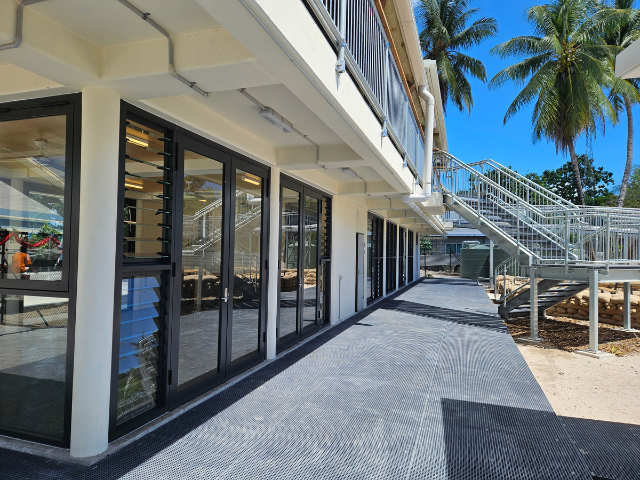
Youth Learning Centre, Kiribati
The growing use of fibre-reinforced polymer (FRP) for tracks, boardwalks and viewing structures reflects a broader shift towards more resilient infrastructure. As bushfire risk, environmental protection and maintenance costs continue to shape project requirements, FRP is proving to be a practical alternative to traditional materials.
BUSHFIRE RISK AND WHY MATERIAL SELECTION MATTERS
A wet spring often creates heavier fuel loads ahead of summer. Combined with increased visitor activity and construction works, this can elevate fi re risk across parks and reserves.
For outdoor access structures in bushfire-prone locations, a BAL40-rating is often a key requirement. Terra Firma’s BAL40-certified FRP grating is designed to perform under conditions involving radiant heat, ember attack and direct flame contact. Just as importantly, FRP structures can be installed without hot works such as welding and grinding, eliminating a common source of sparks during construction.
The material is also lightweight and well suited to remote locations where access is limited. Unlike traditional materials, FRP does not rot, rust or require regular recoating, helping reduce maintenance requirements over the life of the asset.
WHAT SPECIFYING AN FRP FIRE RATING INVOLVES
Meeting an FRP fire rating is about more than selecting a compliant product. Structural analysis, load calculations, material verification and engineering certification all play a role in ensuring a project meets its safety and performance requirements.
This process is particularly important for projects in remote or high-risk environments. When Reeves International required fire-rated access structures for the Youth Learning Centre and Institute of Technology in Kiribati, Terra Firma was engaged during the design phase to help assess load requirements, undertake structural analysis and provide engineering certification. By resolving these requirements early, the project team was able to specify a solution that met performance objectives before the products were manufactured and shipped from Australia for installation onsite.
Engaging FRP specialists early in the design process can help project teams confirm compliance requirements, reduce design risks and avoid costly changes later in the project lifecycle.
WHEN THE SITE ITSELF IS THE CHALLENGE
Many park and reserve projects are located in areas where heavy machinery, vehicle access and hot works are impractical or prohibited. In these situations, prefabricated walkways offer significant advantages because they can be manufactured offsite and assembled with minimal disruption.
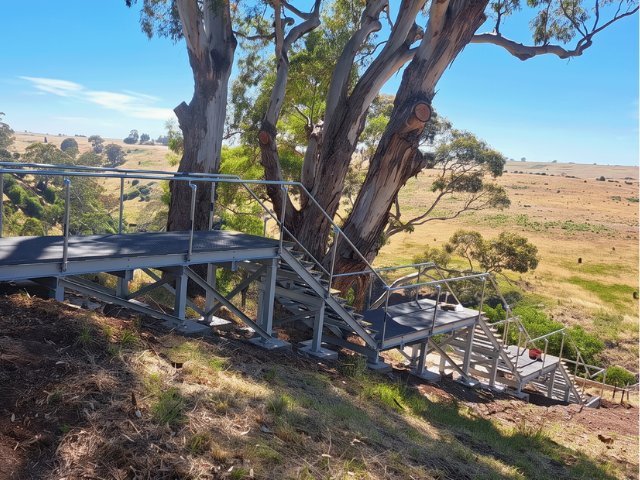
Turpin Falls, VIC
The Turpins Falls lookout had been closed for five years due to difficult site conditions. Steep terrain made vehicle access impossible, while hot works were not permitted. Terra Firma designed and fabricated the viewing platform and staircase offsite before transporting the prefabricated sections along narrow bush tracks for assembly.
By eliminating onsite welding and grinding, the project reduced installation risk while minimising environmental impact. The completed structure allowed the lookout to reopen without major disturbance to the surrounding bushland.
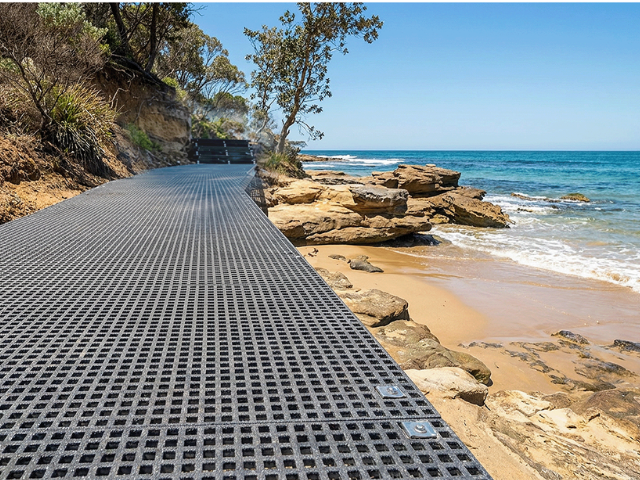
Bundian Way Walking Trail, NSW
The Bundian Way heritage trail required infrastructure that could adapt to steep terrain and sensitive natural surroundings. Terra Firma supplied a complete composite boardwalk and stair system that was manufactured offsite and installed without onsite fabrication, heavy machinery or hot works. The modular design enabled efficient installation while helping preserve the surrounding environment.
A SMARTER STANDARD FOR OUTDOOR INFRASTRUCTURE
Whether the project is located in a fire-prone reserve, a remote trail network or a busy public destination, fire safety should influence both material selection and installation methods. With BAL40-compliant performance, low maintenance requirements and suitability for challenging environments, an FRP boardwalk offers benefits that extend well beyond bushfire resilience.
As councils and land managers seek safer, longer-lasting infrastructure solutions, fire-rated FRP is increasingly becoming the logical default for outdoor access projects across Australia.
Visit Terra Firma via the links below to learn more
