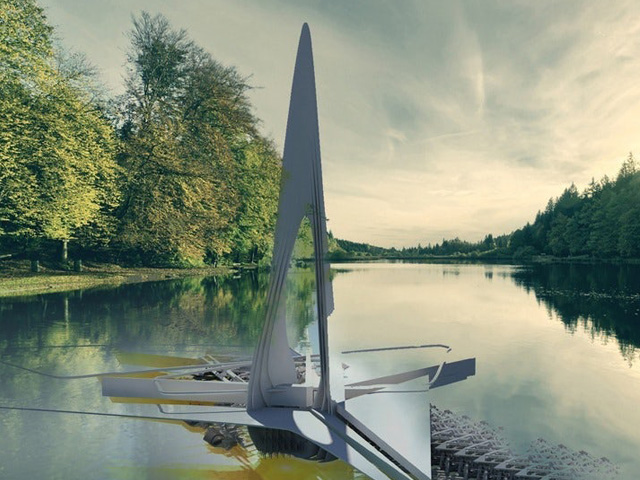

Known for pushing the boundaries of architectural form, geometry, sustainability and smart materials, Margot Krasojević has unveiled her latest project, the revolving sail bridge.
The geometrical bridge, which some have likened to a robotic dragonfly, is being commissioned by the Ordos Government in the Kangbashi district of Mongolia, to cross the Wulanmulun River located in Ordos City. 
The proposal of the revolving sail bridge from Margot Krasojević Architects is a flexible structure that can relocate by sailing along the river to its new position. The bridge consists of a main floating section that supports three expanding walkways, and a carbon fibre triple sail.
Thanks to its transformable nature, the moving bridge can fold its multiple sections in a stackable way to move along the river in a more natural way. Its flexible walkways adapt to different quays and span across the river, expanding and folding according to site-specific requirements. 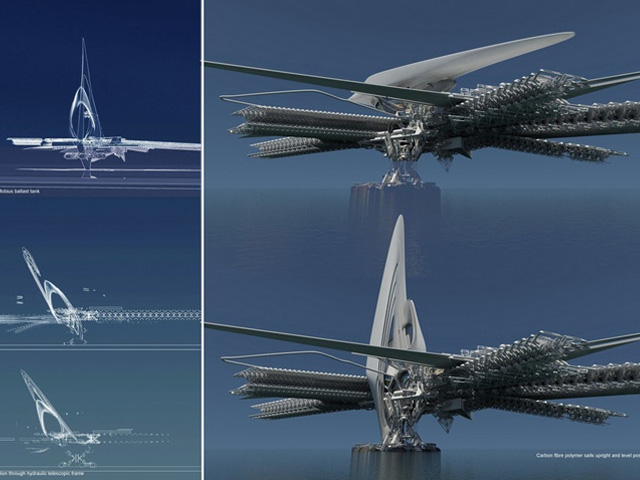
The hydraulic walkway is supported by the river bank’s landing docks while the main body of the bridge is kept afloat by the sail and its rotator. When the bridge is in use, the sail is lowered and acts as a canopy over a seated area for people to enjoy the views and the platform gardens. In addition, solar panels line the walkway of the bridge, providing energy for the three electric motor generators. 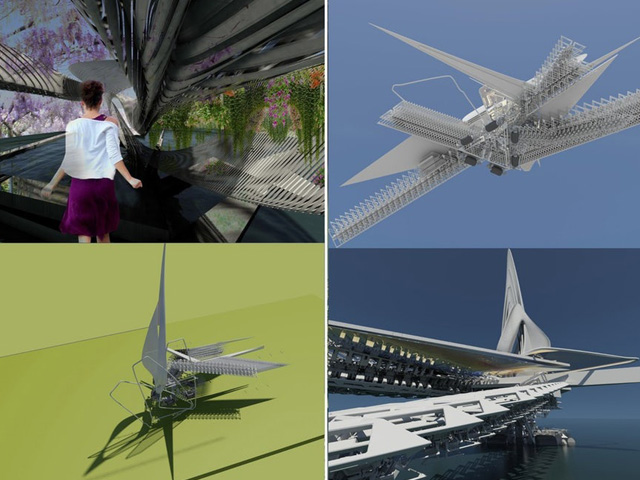
The bridge can be towed, sailed or motored into different locations. A series of cylindrical crossflow turbines skim the water’s surface, while their buoyancy aids in the support and stabilisation of the bridge’s primary structure as it acts as a raft.
Finally, to ensure that the movement of the bridge’s sail does not topple the structure, the sails are also attached to eight marine floatation air bags to stabilise the sails as they revolve, and evenly distribute weight.