
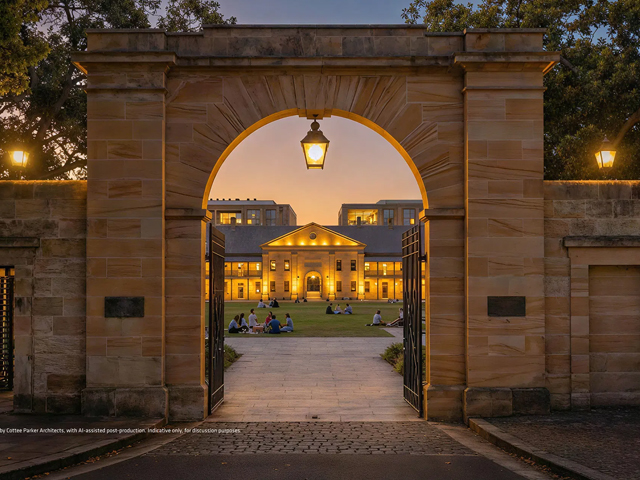
The concept, emerging from the Federal Government's recent Defence Estate Audit that will see the divestment of surplus Department of Defence land, reimagines the 15-hectare Paddington site as a mixed-use precinct incorporating public open space, cultural facilities, hospitality and potentially housing.
City of Sydney Deputy Lord Mayor Zann Maxwell has released the first visual and spatial concepts for its future, working with Cottee Parker Architects and Arterra Interactive to translate it into a place-based vision. The work is not a development proposal, but an early exploration of how the site could be opened up, structured and used as part of the wider city.
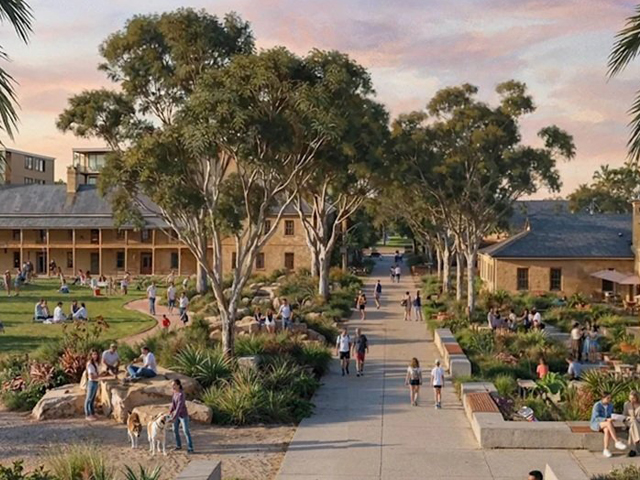
The concept centres on opening up the historically restricted site and transforming it into a multi-use destination. Listed on the Commonwealth Heritage List, it remains one of Australia’s most significant Georgian military buildings. The approach focuses on reworking existing heritage buildings, giving them new life while maintaining their historical significance. The idea is to shift the site from a closed-off military space into something that can be accessed and experienced by the public.
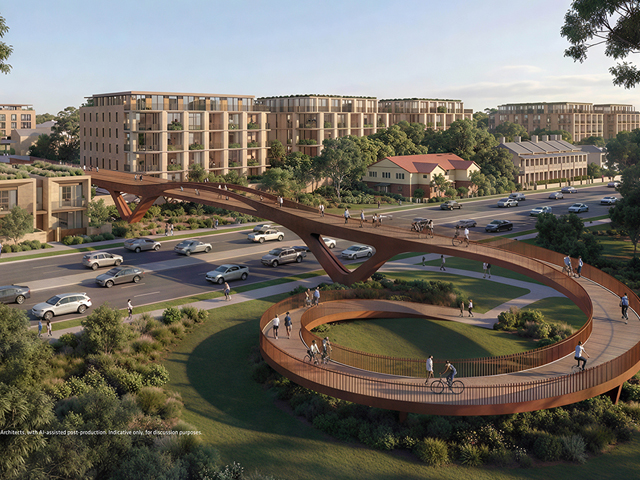
The central move is straightforward: creating a space that feels integrated into the city, somewhere people can pass through, spend time and return to regularly. New pedestrian connections are shown linking Oxford Street through to Moore Park, allowing the surrounding neighbourhood to pass through the barracks for the first time. This shifts the site from a closed compound to part of the city’s everyday movement network.
Maxwell explains, “This vision is about helping people imagine Victoria Barracks as part of everyday Sydney life. Somewhere you can walk through, throw down a picnic blanket, or pop into a wine bar or gallery in the heritage buildings.”
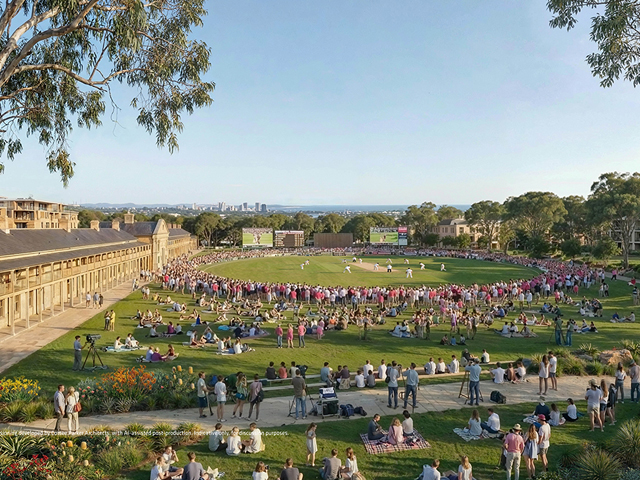
The parade ground sits at the centre of the proposal and is retained as a continuous open space rather than being built over. It is positioned as a major piece of public domain, capable of supporting daily use, events and larger civic gatherings. Maxwell frames the opportunity in broader terms: “If we get it right, this is an opportunity to create Sydney’s next great public place.”
Around this open space, the existing heritage buildings are adapted for new uses. The concepts suggest a mix of cultural, community and small-scale commercial programs that would bring activity into the site while maintaining its character.
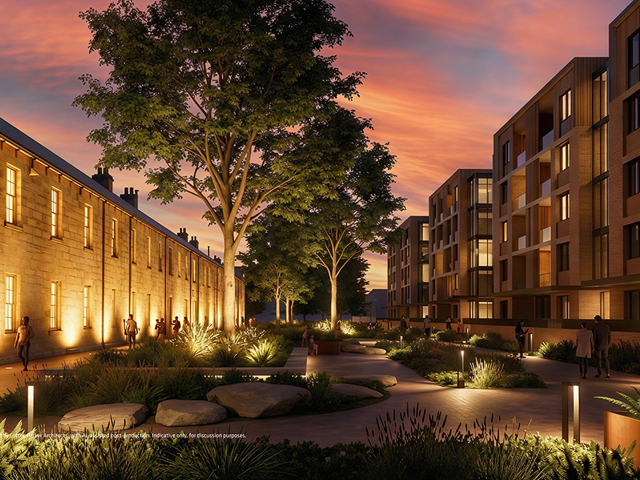
Cottee Parker’s Angelo di Marco highlights the spatial qualities already present, noting that “What makes Victoria Barracks in Paddington so compelling is the powerful contrast it holds between the fine-grain, richly textured neighbourhood beyond its edges, and the expansive, ordered landscape within. Few sites in Sydney offer this kind of duality.”
“Handled well, it has the potential to gently reknit Paddington, opening up meaningful new pedestrian connections through to Sydney’s celebrated sporting and entertainment precinct, and inviting people into a place that has long been closed.”
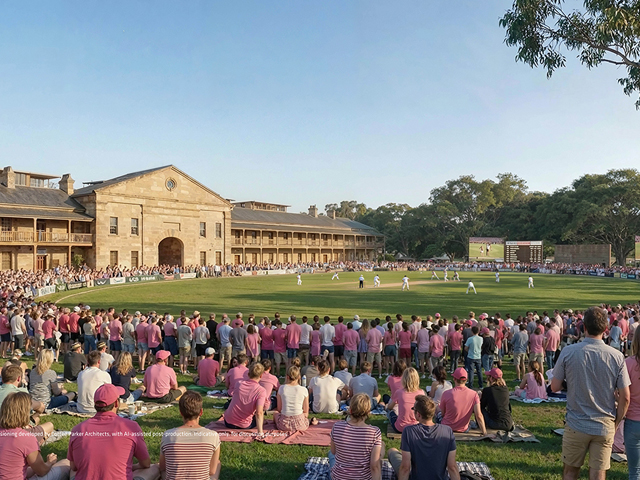
The work itself is intended as an early step in testing these ideas: “Before the opportunity passes, we felt it was important to engage with the City of Sydney’s vision and help bring it to life to test ideas, to explore possibilities, and to demonstrate what could be achieved if we approach this site with care, ambition and a genuine commitment to the public realm.”
Alongside the design approach, Maxwell is calling for a coordinated planning process to guide the site’s future, rather than fragmented outcomes. “We need publicly led masterplanning that delivers long-term public value here, not a piecemeal, developer-led process that falls short of what this site could be.”
At this stage, the proposal is not a confirmed development plan, however, the City of Sydney has already endorsed guiding principles for potential future public use, highlighting opportunities for green space, housing and cultural activation while emphasising the need to protect the site’s heritage significance.