
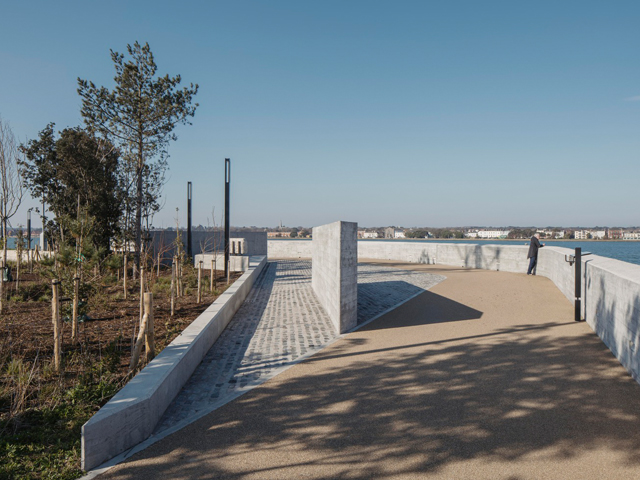
Text description provided by the architects. Tolka Estuary Greenway at Dublin Port forms part of Dublin Port's "Distributed Museum" initiative and was opened to the public in September 2024. Located on Dublin Port lands along the northern edge of the port peninsula, the 2.2km greenway has delivered views of the city, the bay, and the port from lands that were previously inaccessible wasteland.
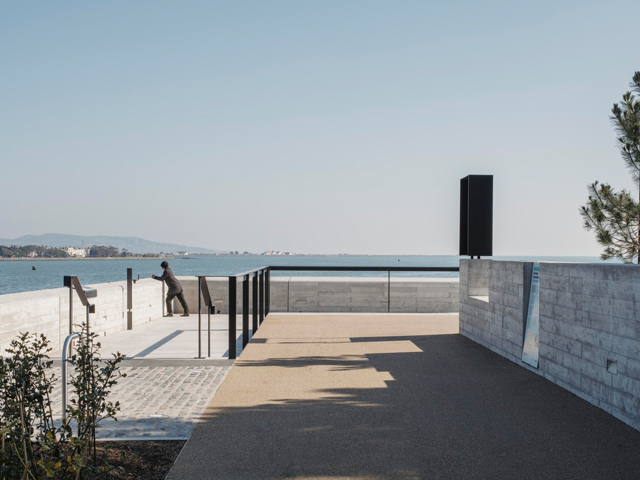
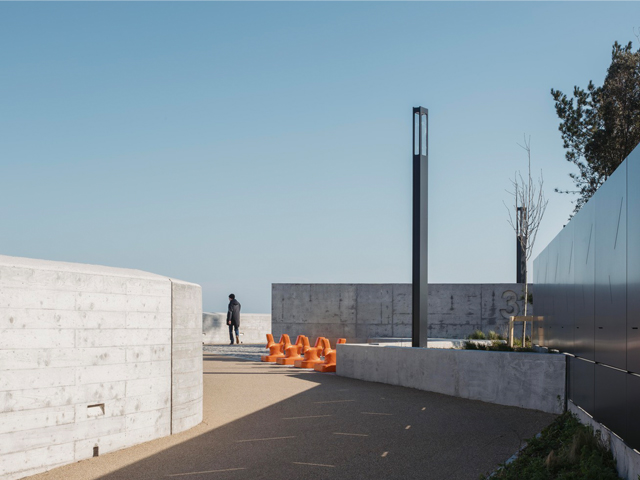
The greenway choreographs a series of three distinct spaces with a minimal, yet refined palette of materials. In addition to robust board-marked concrete walls, matching the industrial scale of the setting, there is a series of black metalwork feature gates, balustrades, and screens. Dublin Port salvage includes dockside moorings, granite blocks from the Alexandra Basin redevelopment, a wrecking ball sited to counterbalance a cantilevered wall, cobble setts, and a Latin inscribed granite block. A layer of interpretation celebrates Dublin Port's industrial heritage, its history, daily activities, and the local biodiversity.
The entrance is situated at the terminus of the future Liffey Tolka Project. One enters through a deep threshold gateway and ascends a gentle slope, with the first of the feature concrete walls guiding users toward a mature woodland.
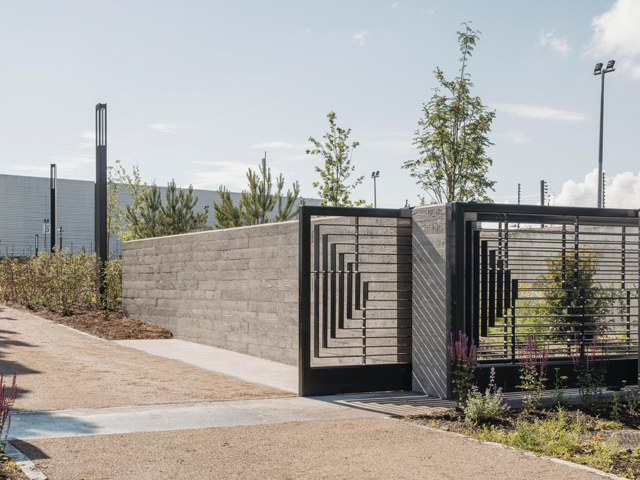
At Discovery Point One, one emerges from the woodland through Parallel Walls; the North Wall is cut short to invite views towards Clontarf. The South Wall continues to form a relationship with the horizon and bears a monolithic open frame at its endpoint. The Sea Wall pivots towards Dublin Bay and bounds a sunken area, allowing unobstructed views from the main route above.
Discovery Point Two is conceived as an orthogonal free plan with four walls extending out from a central space in a pinwheel configuration. These walls set up north, south, and east access points. The main route again passes a sunken area, with the curved sea wall thickened to protect the bird sanctuary below.
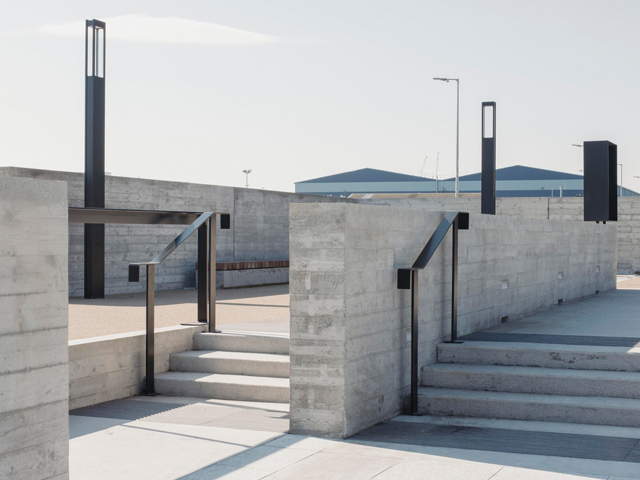
Discovery Point Three is a radial design strategy used to emphasize the outward expanse of Dublin Bay. An 18m long steel wall (with a pattern depicting the radial walls) sits at right angles to the central Radial Wall, which itself screens immediate views to the Main Space behind. One freestanding wall frames the Poolbeg Chimneys beyond. The Sea Wall, stretching like a ribbon, was built inside an existing ring beam at the top of the revetment, with deterrent feature stones installed to the seaward side.
All surface water run-off has been dealt with sustainably, with weep holes to all the bases of all sea walls and run off also to planted verges. In addition to using salvaged material for paving and seating the sea wall at Discovery Point Three was built within an existing revetment ring beam. The route of the greenway was also carefully aligned to retain existing mature trees, with 473 new trees planted.
TOLKA ESTUARY GREENWAY
LOCATION Dublin, Ireland
ARCHITECT TTT + Darmody Architecture
PHOTOGRAPHY Fiona McCann